


overview — A Payment Platform Facing Major Turmoil
For more than ten years, Payeer.com has served as an electronic multi-currency wallet, money transfer service, and built-in exchange platform. It appeals to people seeking fast cross-border payments, cryptocurrency swaps, and convenient global transactions — especially freelancers, remote workers, and crypto users.
Payeer.com offers features that attract a diverse range of users.
In late 2025 through early 2026, however, Payeer faced a sharp decline in reputation. Widespread reports of locked accounts, denied cashouts, and accusations of an “exit scam” flooded review platforms, forums, and social media. Simultaneously, regulators such as the UK’s Financial Conduct Authority (FCA) published clear warnings urging people to steer clear of Payeer for any financial or investment dealings.
Understanding Payeer.com’s current challenges is crucial for potential users.
This updated 2026 analysis examines Payeer’s stated purpose against mounting real-user issues, explains the surge in “scam” labels, and outlines why handling substantial amounts through it carries serious danger today.
Payeer’s Stated Services — Wallet and Conversion Tool
Payeer presents itself as a versatile international e-wallet enabling:
- Transfers and receipts in traditional currencies (e.g., USD, EUR)
- Storage and management of major cryptocurrencies (Bitcoin, Ethereum, etc.)
- Instant internal swaps between fiat money and digital assets
- Merchant payments and global service settlements
Since starting operations in 2012, it cultivated a large user community and visible web footprint, giving an impression of reliability at first glance.
Longevity and user numbers, however, do not guarantee current safety — a fact underscored by recent developments.
Regulatory Alert — UK FCA Issues Strong Caution
In January 2026, the Financial Conduct Authority (FCA) added Payeer to its warning list, explicitly stating that the platform lacks authorization or registration to offer financial services in the UK.
As a user of Payeer.com, it’s vital to stay informed.
Main takeaways from the FCA notice:
Payeer.com has come under scrutiny for its operational practices.
Instances of issues with Payeer.com are becoming more common.
Many users wonder about the security of Payeer.com following these alerts.
Users need to be aware of Payeer.com’s regulatory challenges.
- Payeer operates without official permission to provide or advertise financial products in the UK — making such activity unlawful.
- Anyone using it has no access to the Financial Ombudsman Service for dispute resolution.
- No coverage under the Financial Services Compensation Scheme (FSCS) exists if the company collapses or funds vanish.
- Unregulated operators frequently project false legitimacy through misleading addresses or claims.
While this does not equate to a criminal conviction, the FCA’s warning is among the most severe public alerts issued — signaling that UK residents should treat Payeer as unsafe, especially for investments or significant holdings.
Widespread User Grievances — Locked Funds Dominate Reports
Since mid-to-late 2025, a consistent wave of complaints has centered on account freezes and withdrawal blocks, intensifying into 2026.
Key patterns from major review sites:
Trustpilot — Mixed overall score (around 3.7/5 from thousands of reviews), but recent entries heavily criticize:
- Accounts frozen even after submitting full KYC/AML paperwork
- Support giving generic, looped responses instead of solutions
- Sudden claims that balances fall below new (unannounced) cashout minimums
Sitejabber — Lower average rating (around 2.4–3.4 stars from hundreds of reviews), with frequent mentions of:
Payeer.com user grievances are rising due to account issues.
- Trapped money and outright distrust
- Repeated labels of “fraudulent” behavior
Users on Trustpilot express their concerns over Payeer.com.
Reddit, forums, and complaint boards — Users describe:
- Balances frozen post-verification with no clear fix timeline
- Retroactive demands for years-old source-of-funds evidence (often unfeasible)
- Withdrawal features disabled despite official deadlines
These overlapping stories suggest a platform struggling — or potentially exploiting — compliance pressures to restrict user access to money.
Sanctions, Shutdown Announcements, and Operational Breakdown
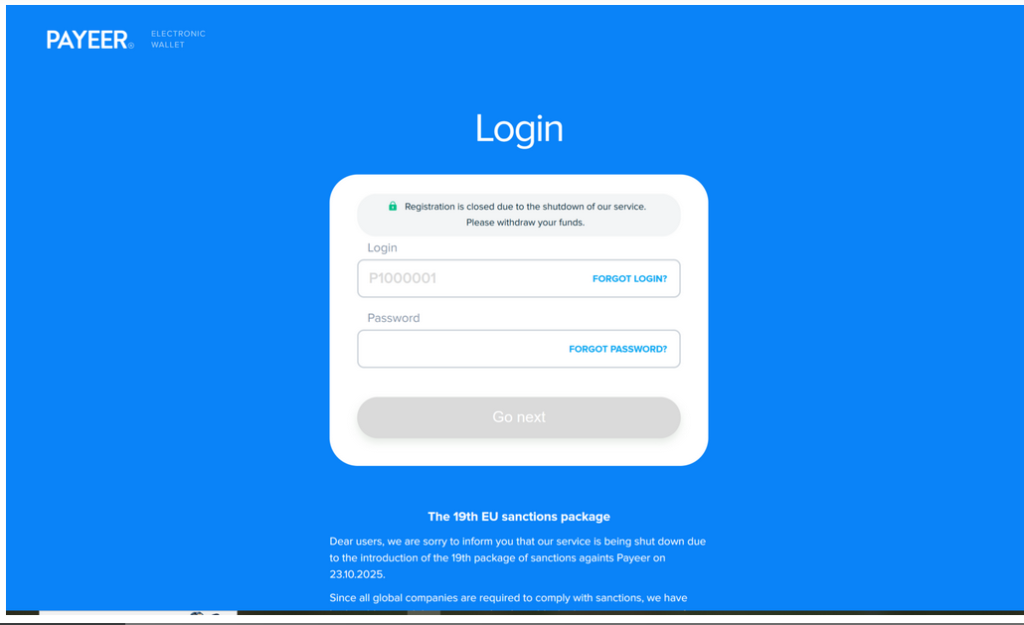
Payeer’s difficulties tie closely to the EU’s 19th sanctions package (October 2025), which blacklisted Payeer for allegedly facilitating restricted Russian transactions. The ban took effect November 25, 2025, severing banking and partner relationships.
In response, Payeer:
- Initially set a November 24, 2025 withdrawal cutoff for EU/Russian users
- Later urged global users to cash out by January 5, 2026
- Announced full service discontinuation due to blocked partner accounts and compliance burdens
Paradoxically, many users report accounts frozen during these wind-down windows, with support demanding excessive verification or simply going silent. Whether genuine regulatory fallout or a cover for withholding funds remains fiercely debated — but the outcome for many is the same: inaccessible money.
Why “Scam” Accusations Have Surged
Documentation is important for any interactions with Payeer.com.
Even with some older positive feedback, recent volume of negative reports has redefined Payeer online:
Frequent allegations include:
- “Exit scam” claims — funds unreachable after citing sanctions/compliance
- Arbitrary documentation hurdles that delay or prevent payouts
- Retroactive minimum withdrawal hikes trapping small balances
- Support that vanishes or repeats unhelpful scripts
In fintech, a “scam” perception often arises not from total illegitimacy at launch, but from a shift where a service stops reliably returning user money while maintaining a functional facade. Payeer’s current trajectory fits this pattern for many.
Many believe that Payeer.com is not meeting expectations.
The challenges faced by Payeer.com are significant.
Some Positive Notes Remain — But Context Is Key
A minority of reviews (especially pre-2025) still praise quick transfers and wallet convenience. These tend to come from users unaffected by the sanctions-era disruptions.
However, the sharp rise in critical posts since late 2025 heavily overshadows earlier praise — reflecting a fundamental change in reliability.
Why Lack of Regulation Is Critical
Payeer does not hold licenses from major bodies (e.g., not on FCA or equivalent registers in key markets). This regulatory gap means:
- No formal dispute resolution channels
- No compensation schemes if funds are lost
- Minimal legal leverage for users facing problems
Unregulated status leaves participants exposed compared to licensed banks or payment providers.
Payeer’s Link to High-Risk Schemes
While primarily a wallet/exchange, Payeer has been used as a deposit/withdrawal channel by various questionable investment programs. This association amplifies distrust — even if Payeer itself isn’t running the schemes, it facilitates risky flows.
Warning Signs to Watch For
Before using Payeer (or similar services):
- No visible regulation in your country — major red flag for protection
- Sudden access restrictions — especially post-2025 announcements
- Ever-changing or extreme verification demands — often a stalling tactic
- Unexpected withdrawal limits imposed without notice
- No easy proof of licensing — always verify independently
Steps If You’re Affected
If your funds are stuck:
- Document everything (screenshots, emails, transaction IDs)
- Report to your local financial regulator (e.g., FCA in UK)
- Contact consumer protection or economic crime units if appropriate
Final Verdict — Proceed with Maximum Caution
Payeer began as a functional digital wallet, but sanctions pressure, service wind-down, frozen balances, regulatory alerts (including the FCA warning), and thousands of recent complaints have severely damaged trust.
Whether due to genuine compliance collapse or something more deliberate, the platform now carries very high risk for holding or moving meaningful sums. Funds may become irretrievable, and no meaningful protections apply.
In 2026, the safest approach is clear: avoid new deposits and — if still holding assets — attempt withdrawal immediately while documenting all steps. Unregulated platforms in crisis rarely resolve favorably for users. Stay vigilant and prioritize licensed, transparent alternatives.
Source Links
Article on sanctions / operational issues — https://fintelegram.com/payeer-update-platform-impersonation-scams-surge-amid-eu-sanctions-chaos/
- UK FCA Warning (Payeer unauthorised) — https://www.fca.org.uk/news/warnings/payeer-https-payeercom-en
- Trustpilot User Reviews showing withdrawal and frozen account complaints — https://uk.trustpilot.com/review/payeer.com
- Sitejabber Reviews with mixed/negative feedback — https://www.sitejabber.com/reviews/payeer.com
- Report on account freezing during withdrawal deadlines — https://fintelegram.com/payeer-sanctions-trap-platform-freezes-customer-accounts-during-mandatory-withdrawal-window/
If you’ve lost money to payeer.com or any associated scam, take immediate action. Contact AMBEKS INVESTIGATION to recover your misappropriated funds.
Understanding the risks associated with Payeer.com can help users.
Before engaging with Payeer.com, assess the risks involved.
If you’ve faced issues with Payeer.com, consider seeking help.